



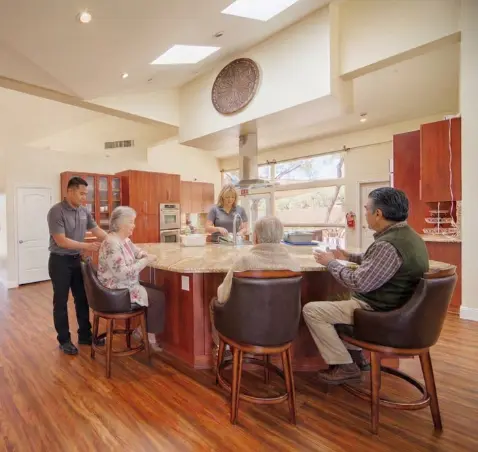
For many Tucson couples, the decision to move into assisted living comes with a difficult question: what happens when one spouse needs daily support and the other does not? A new Arizona law gives assisted living communities more flexibility to accommodate situations like these.
Senate Bill 1247, which took effect on April 6, 2026, allows a person who does not receive assisted living care services to live with a resident in an assisted living center or assisted living home, as long as the facility allows the arrangement.
Quick answer: SB 1247 can make it possible for a spouse or another individual who does not need supervisory, personal, or directed care services to live with someone who does need assisted living care. The law does not require every assisted living community to offer this arrangement. Rather, it removes certain state regulatory barriers when a community chooses to allow it.
What Tucson Families Should Know
-
SB 1247 applies to both assisted living centers and assisted living homes in Arizona.
-
The person living with the resident does not have to receive assisted living services simply because they share the residence.
-
The arrangement still must be allowed by the individual assisted living center or home.
-
Tucson families should ask about residence policies, room availability, fees, care plans, and what happens if the non-care-receiving spouse later needs assistance.
-
Families throughout Pima County, including those in Oro Valley, Marana, Catalina Foothills, Green Valley, and Sahuarita, may want to include this new option when comparing assisted living arrangements.
What Does Arizona SB 1247 Actually Change?
Arizona SB 1247 changes assisted living occupancy rules by allowing someone who does not receive supervisory, personal, or directed care services to live with an assisted living resident when the assisted living center or home permits it. The person may live in the resident’s unit or another unit within the community.
The legislation also states that the Arizona Department of Health Services may not require that person to have a service plan or receive assisted living services merely because the person lives there. DHS also may not impose requirements on that individual that a resident would not have to meet.
Although the change is especially relevant to married couples, the statutory language is broader. It refers to an “individual” living with a resident, rather than limiting the option specifically to spouses.
Does SB 1247 Guarantee That Couples Can Live Together?
SB 1247 does not guarantee that every couple can share accommodations at every Arizona assisted living community because the law expressly makes the arrangement dependent on whether the assisted living center or home allows it.
For Tucson families, this distinction is important when comparing communities.
A family should not assume that every assisted living residence has the same occupancy policy, floor plan, pricing structure, or available space. Before making a decision, ask the community directly whether a spouse who does not need care can live with a resident and what conditions apply.
Why Does This Matter for Tucson Families?
This law matters for Tucson families because couples can have very different care needs even after spending decades living together, and SB 1247 gives assisted living providers greater flexibility to accommodate those differences without automatically requiring both people to receive care services.
Consider a couple living near the Catalina Foothills. One spouse may need help with medications, bathing, dressing, or other activities of daily living while the other remains largely independent. Before choosing a residence, that family can now explore whether an assisted living community permits both partners to live there while services are provided only to the person who needs them.
The same issue can affect families moving from Oro Valley, Marana, Green Valley, Sahuarita, or other parts of Pima County who want to remain close to their established doctors, family members, friends, and familiar Tucson-area routines.
When Did the New Arizona Assisted Living Law Take Effect?
SB 1247 took effect on April 6, 2026, because the final legislation included an emergency clause making it operative immediately after approval rather than waiting for Arizona’s general effective date for legislation passed during the session.
The measure became Chapter 14 of Arizona’s 2026 session laws and added A.R.S. § 36-407.04, addressing occupants of assisted living centers and assisted living homes.
For families researching senior living now, this means SB 1247 is already in effect.
How Could the Law Affect Assisted Living Decisions?
SB 1247 can affect assisted living decisions by giving families another possible living arrangement to discuss when one person needs care and the other does not.
At The Gardens at San Carlos, we understand that assisted living decisions involve more than identifying care needs. Families may also be thinking about companionship, familiar routines, proximity to loved ones, future care needs, and whether a move will require a long-time couple to maintain separate homes.
Because SB 1247 leaves participation to each assisted living provider, we encourage families to ask specific questions about current residence policies and available options rather than assuming the law creates the same arrangement everywhere.
What Questions Should Couples Ask an Assisted Living Community?
Couples should ask whether the community permits a non-care-receiving spouse or other individual to live with a resident and how that arrangement works in practice.
Useful questions include:
-
Can a spouse who does not currently need assisted living services live with a resident?
-
Can the couple share the same unit?
-
Are there different housing or occupancy charges for the second person?
-
What services or amenities are included for the non-care-receiving occupant?
-
What happens if that person’s needs change later?
-
Are suitable units currently available?
-
How are meals, activities, transportation, or other community services handled?
-
What documents are required before both people can move in?
Getting these answers early can make it easier for families to compare Tucson-area assisted living options on equal terms.
What Are Common Local Scenarios Where SB 1247 May Help?
A common Tucson-area scenario involves one partner developing care needs before the other, creating a choice between remaining together at home, maintaining separate residences, or finding a community that can accommodate both people.
For example, imagine a couple who has lived in Pima County for decades. One spouse now requires regular personal care, while the other can manage most daily activities independently. Their adult children may live elsewhere in the Tucson metro area and want their parents to remain close to one another without purchasing unnecessary care services for the independent spouse.
SB 1247 gives assisted living providers a legal pathway to consider such an arrangement when their policies, accommodations, and availability permit it.
This is a common local scenario for explanation purposes, not a specific resident case.
What Should Families Consider Beyond Staying Together?
Families should consider care quality, safety, future needs, living arrangements, finances, and compatibility with the community in addition to whether a couple can remain under the same roof.
Staying together may be an important priority, but Tucson families should also ask whether the residence can appropriately support the person who needs care today and whether suitable options may exist if either partner’s needs change.
A useful assisted living conversation should cover current care requirements, medication support, mobility, personal care, meals, social activities, transportation needs, room configuration, and future planning.
Comparing Your Options Under the New Law
Families can compare living together in an assisted living setting with other arrangements by looking at care needs, housing preferences, finances, and how much separation each option would require.
A couple might consider remaining together at home with outside support, having one spouse enter assisted living while the other stays at home, or choosing a community that permits both people to reside there under SB 1247.
There is no single arrangement that fits every family. The new law simply expands the possibilities Arizona families can explore with participating assisted living providers.
What Happens If Families Wait to Discuss These Options?
Waiting to discuss assisted living options can reduce a family’s choices if care needs increase unexpectedly or preferred accommodations are unavailable when a move becomes necessary.
For Tucson families, early planning can provide time to tour communities, understand policies, compare living arrangements, review costs, and discuss what each partner wants before a health change creates greater urgency.
SB 1247 adds another question worth including in those conversations: whether a community can accommodate one person who needs assisted living care and another who currently does not.
Frequently Asked Questions About SB 1247 and Assisted Living in Tucson
SB 1247 gives Arizona families a new assisted living occupancy option, but individual community policies still determine whether a particular arrangement is available. Here are answers to common questions Tucson-area families may have.
Can my spouse live with me in assisted living in Tucson if they do not need care?
Potentially, yes. Arizona law now allows a person who does not receive supervisory, personal, or directed care services to live with an assisted living resident if the assisted living center or home permits the arrangement. Families should confirm the specific residence’s policy and availability before making plans.
Does my spouse have to purchase assisted living services just to live with me?
No. Under A.R.S. § 36-407.04, the Arizona Department of Health Services may not require a qualifying non-care-receiving occupant to have a service plan or receive supervisory, personal, or directed care services simply because that person lives in the assisted living setting.
Does every Tucson assisted living community have to accept couples under SB 1247?
No. SB 1247 specifically applies when the assisted living center or assisted living home allows the arrangement. The law removes certain state requirements but does not compel every provider to offer shared residency to a person who does not need assisted living care.
Does SB 1247 apply only to married couples?
No. The statutory language refers to an “individual” who does not receive supervisory, personal, or directed care services and does not limit the provision specifically to a husband, wife, or legally married spouse. Whether a particular living arrangement is available still depends on the provider’s policies.
Does the law apply to smaller assisted living homes in Pima County?
Yes. The final version applies to both assisted living centers and assisted living homes. Arizona defines assisted living centers and smaller assisted living homes separately, but the final legislation extended this occupancy provision to both categories.
When did SB 1247 become effective in Arizona?
SB 1247 became effective on April 6, 2026. The Legislature passed it with an emergency provision, and the enacted law states that it became operative immediately. Families in Tucson and elsewhere in Arizona can therefore ask assisted living providers about policies under the law now.
Explore Assisted Living Options While Staying Close to What Matters
For Tucson families, SB 1247 creates another possibility to consider when one partner needs assisted living support and the other does not. The right arrangement still depends on individual needs, community policies, available accommodations, and long-term plans.
At The Gardens at San Carlos, we can help families have informed conversations about assisted living options and the questions that matter most to them.